Authority article
Schools in Portugal for expat families: public, private, international, and what changes when you move

If you are moving to Portugal with children, school choice rarely stays "just" a school question.
Most guides show lists of schools. They often leave out what changes when you are still choosing where to live, do not yet have your Portuguese admin in order, or are trying to line up school timing with the rest of the move. That overlap is often where confusion starts for relocating families.
This guide gives you the practical first answer: what public, private, and international school routes usually mean in Portugal, what changes when you are moving rather than already settled, and when the question stops being a school comparison and becomes a wider admin problem.
This is not a rankings page, a directory, or an admissions guarantee. It is a planning guide for families who want to make a better decision before they lock in the wrong location, the wrong timing, or the wrong assumptions.
This guide is practical information based on current public guidance and Ponte's client-support experience. It is not legal, tax, immigration, healthcare, or financial advice. Requirements can vary by municipality, institution, and personal situation.
How the main school routes in Portugal differ for relocating families
Portugal has more than one school path, but the important difference for expat families is not only academic. It is operational.
The route you choose can affect where you need to live, how early paperwork matters, how much flexibility you have, and how much of your move has to be in place before you can act.
As a baseline, Portugal's public system includes pre-school from age 3 in the public network, and compulsory schooling runs for 12 years starting at age 6. That matters because the school decision changes depending on whether you are planning for pre-school access, first entry into compulsory schooling, or a later transfer.
Public schools
For many families, public school is the first route they want to understand because it is the most integrated with where daily life will happen.
Public school can be a strong fit if you want your child in the local system, you are planning your move around a specific area, and you are comfortable treating school choice as part of your municipality and residence setup rather than as a separate consumer decision.
The tradeoff is that public-school enrolment is tied more visibly to process. Public enrolment and renewals run through the Portal das Matrículas or in person at the educational establishment. The caregiver typically logs in using Portuguese authentication methods, and the process can require identity details, tax numbers, Social Security numbers, a student photo, and sometimes proof of residence or other supporting documents. After an application is accepted, the school may still request more documents.
That does not mean every family will face the same checklist in the same order. It does mean public school tends to connect quickly to address status, municipality context, and document readiness.
Private schools
Private schools sit in a different rhythm.
If you choose private education, Portuguese government guidance points families to contact the institution directly. In practice, that usually means the school's own admissions process matters more than the national public-enrolment flow.
For relocating families, that can mean more flexibility in some cases, but it can also mean more variation. Timelines, required documents, fees, and expectations are not one uniform national route just because the school is private.
Private school can make sense when you want a specific educational style or more choice outside the local public assignment logic. But it should not be treated as a shortcut that removes all move-sequence friction. You still need to understand how housing, admin timing, and the rest of your relocation fit around it.
International schools
International schools are usually the route families explore when they want more continuity with a familiar language, curriculum, or cross-border family plan.
The main advantage is often perceived stability for the child. The main mistake is assuming all international schools work the same way.
Admissions calendars, language models, fees, waiting lists, and documentation expectations can vary sharply by school. Many international-school decisions are also really location decisions in disguise, because the school choice can narrow where you can realistically live and how much commuting friction the family can absorb.
So the useful question is not only, Do we want an international school?
It is, What does this choice commit us to in the rest of the move?
What changes when you are moving, not already settled
The same school route can feel straightforward for one family and complicated for another because the school question is being asked at different moments in the move.
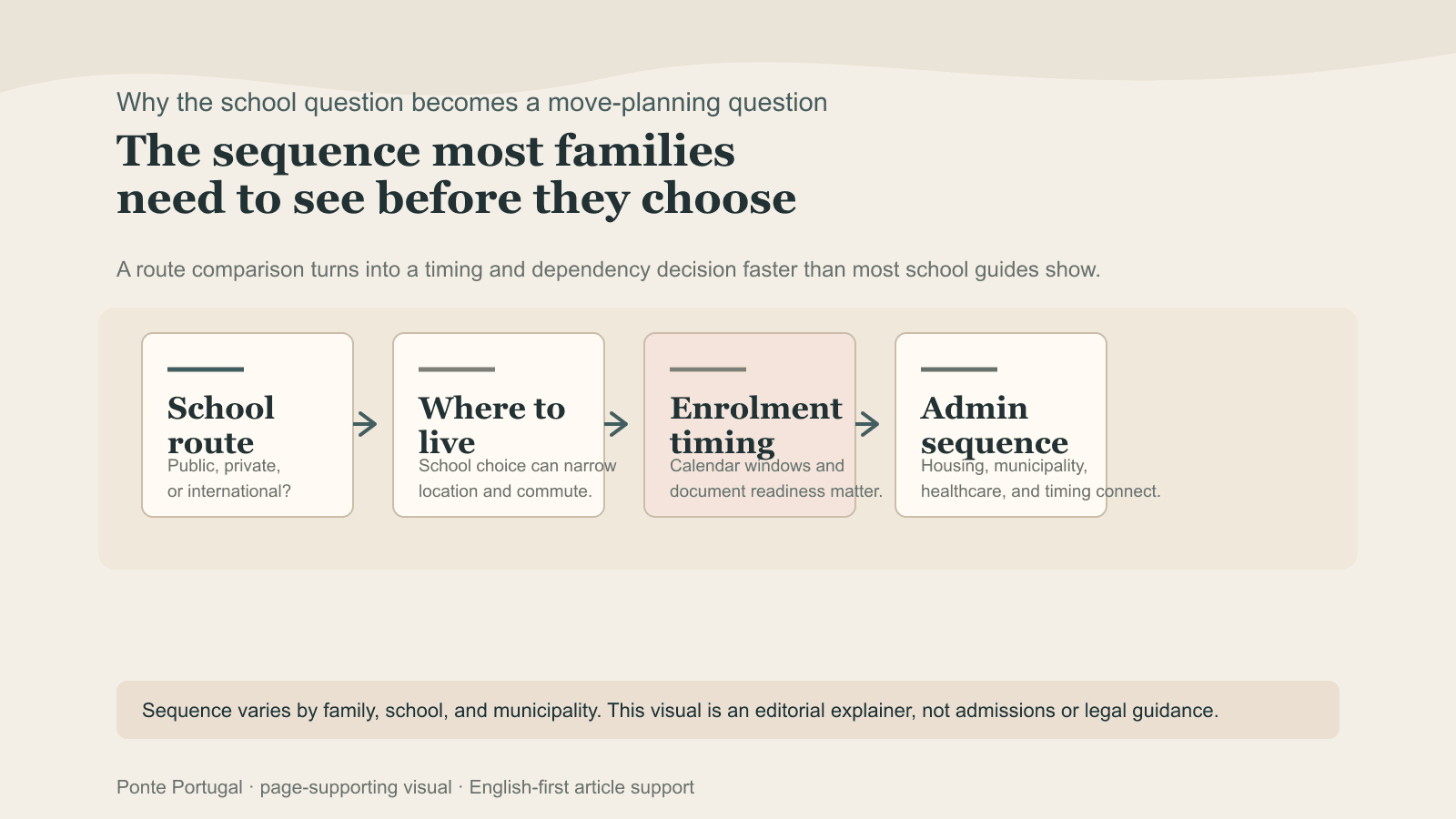
If you are already settled, have an address, know your municipality, and can act inside the current school calendar, the process is easier to reason about. If you are still comparing regions, waiting on housing, or only partly through your Portuguese admin, school choice becomes less about comparing school labels and more about managing dependencies.
One common source of confusion is the overlap between education and relocation:
- a school preference can narrow your location options;
- a location choice can shape your public-school context;
- timing can matter because public enrolment windows run on a school-year calendar rather than on your family's ideal moving date;
- document readiness can matter earlier than expected.
As of April 30, 2026, the official 2026/2027 public-school calendar opens between April 22 and June 1 for pre-school and first grade, June 16 to June 29 for 6th, 7th, 8th, 9th, and 11th years, July 1 to July 13 for 2nd through 5th years, and July 15 to July 22 for 10th and 12th years. That is exactly why school research should start before the family thinks it is ready to enrol. These dates change by year group and by school year, so they should always be rechecked before action.
School choice and school enrolment are not the same step
This is one of the most useful distinctions for relocating families.
School choice is the decision stage:
- Which route fits our child?
- Which area are we considering?
- How much flexibility do we need?
- Are we choosing for curriculum, language continuity, budget, or day-to-day practicality?
School enrolment is the action stage:
- Which process applies here?
- Which dates are live now?
- Which documents are needed?
- Which school or portal are we actually using?
Those are related steps, but they are not the same step.
Families often get stressed because they jump from broad school comparison to assumed enrolment certainty too early. They read one forum answer, one school website, or one expat thread and start planning as if every family follows the same route.
The safer approach is:
- decide which route you are realistically comparing;
- understand what that route depends on in your move;
- only then move into live enrolment mechanics.
That keeps you from making location promises to yourself before you understand what the school choice actually requires.
Where families usually get stuck
A lot of friction comes from sequence mistakes or assumptions carried over from other families' experiences, not from a lack of effort.
Choosing where to live before understanding the school implications
Families often decide on a town or rental first, then discover that the school question changes the practical picture. That can happen with public schools because municipality context matters, but it can also happen with private or international routes if commuting, waiting lists, or logistics turn out to be harder than expected.
Treating one document list as universal
The official public-enrolment guidance already shows why universal checklists are risky: the portal asks for core identity and registration data, may ask for proof such as residence, and the school may still request more documents later. That is before you even get into school-level or route-level variation.
So if a family is relying on one static list from a Facebook group, it is usually too early to treat that as settled truth.
Assuming private or international routes follow one national pattern
They do not. Private and international schools can look simpler from the outside because they are not framed around the public portal. But the tradeoff is variation. Each school can have its own timing, admissions approach, and practical expectations.
Leaving school too late in the move sequence
Some families do not start school research until they already feel behind. The problem with that timing is that school choice then collides with housing, municipality decisions, work plans, healthcare setup, and family stress all at once.
At that point, the school question is no longer isolated. It is part of the move's operating system.
When the question becomes an admin-support problem
The school question can become a wider admin-support question when several linked uncertainties show up together.
That often looks like:
- you are comparing regions and schools at the same time;
- you are unsure how address or municipality context changes the public route;
- you are trying to map school timing against housing and other registrations;
- you are not sure which part of the problem is a school decision and which part is a broader move decision;
- another admin step, such as tax, Social Security, healthcare, or municipality registration, is already creating friction.
At that point, one more generic school guide may not solve the real problem. The real problem is sequence clarity.
Ponte stays conservative here: this article does not promise nationwide admissions handling, direct school placement, or one standard enrolment route for every family. The safer claim is that Ponte can help families think through the move sequence, see where school choice overlaps with the rest of the relocation, and decide when they need a broader next-step conversation.
If healthcare registration or municipality setup is already part of the same family move, you may also want to look at the wider journey, municipality support, SNS registration guidance, NIF support or NISS support.
What to do next if you are deciding now
If you are still early in the decision, do not start by asking for the best schools in Portugal.
Start with the more useful questions:
- Are we comparing public, private, or international schools for the right reason?
- How much does this choice narrow where we can realistically live?
- Are we still in the comparison stage, or are we actually close to enrolment?
- Which part of the move needs clarity first: school route, address, municipality, timing, or wider admin sequence?
That shift matters because school choice in Portugal is usually easier when you treat it as part of your move sequence, not as an isolated comparison.
Need help mapping the family move sequence?
If your school question is really a location, timing, or admin-sequence question, book a quick fit call and we will help you work out what needs to happen first.